
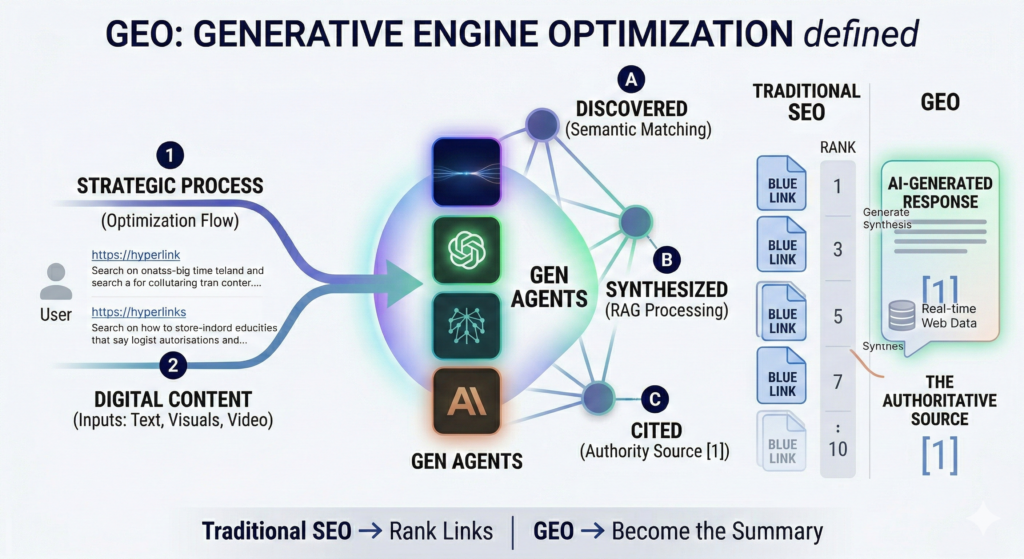
What is GEO (Generative Engine Optimization) in 2026?
Generative Engine Optimization (GEO) is the strategic process of optimizing digital content to be discovered, synthesized, and cited by AI-powered search engines like Gemini, Perplexity, and SearchGPT. Unlike traditional SEO, which focuses on ranking in a list of links, GEO focuses on becoming the authoritative source within an AI’s generated response.
Who This Guide Is For
- CMOs and Marketing Directors looking to future-proof their brand’s digital footprint.
- Content Creators transitioning from “writing for clicks” to “writing for citations.”
- SEO Specialists evolving into the new era of Answer Engine Optimization (AEO).
Why GEO Matters in 2026
By 2026, the traditional search engine results page (SERP) has been largely replaced by Agentic Workflows. Users no longer browse ten blue links; they receive a singular, synthesized answer. If your brand isn’t part of that synthesis, you are invisible. This guide will teach you how to structure your expertise so AI models treat your brand as a primary source.
The Three Pillars of GEO: A Framework for 2026
To win in the age of generative search, your content must move beyond simple keywords and focus on Engine Readability and Trust Signals.
1. Verification & Citation Readiness
AI engines prioritize “verifiable” information. To be cited, your content needs:
- Structured Data (JSON-LD): Giving the AI a clear map of your facts.
- External Linking: Linking to high-authority peer-reviewed sources to validate your claims.
- Unique Statistics: Publishing original data that AI models haven’t “learned” yet.
2. Narrative Clarity & Connectivity
LLMs (Large Language Models) process information through context.
- Entity Linking: Clearly defining the relationship between your brand and specific industry solutions.
- Direct Answers: Lead with a “Bottom Line Up Front” (BLUF) approach to satisfy the model’s extraction needs quickly.
3. Brand Authority & Sentiment
In 2026, “Expertise, Authoritativeness, and Trustworthiness” (E-A-T) is measured by how often other high-quality sources mention your brand in a positive context across the web.
SEO vs. AEO vs. GEO: Understanding the Shift
| Feature | SEO (Traditional) | AEO (Answer Engine) | GEO (Generative Engine) |
| Primary Goal | Rank #1 on Page 1 | Win the “Featured Snippet” | Get cited in AI synthesis |
| Core Metric | Click-Through Rate (CTR) | Brand Impression/Voice | Citation Share & Sentiment |
| Strategy | Keyword Density | Question/Answer Pairs | Context, Structure, & Data |
| Output | List of relevant links | Single direct answer | Multi-source summary + links |
Scenario: The 2026 “Travel Tech” Campaign
Imagine a boutique travel agency, NexusJourneys, trying to rank for “best eco-friendly travel options in 2026.”
- The Old Way: Writing a 2,000-word blog post with the keyword repeated 15 times.
- The GEO Way: 1. Publishing a live data table of carbon footprints for different flight routes.2. Using Schema markup to identify specific “Eco-Certifications.”3. Structuring the article with a clear “Conclusion First” summary.
The Result: When a user asks Gemini, “Plan a green trip for me,” Gemini extracts NexusJourneys’ table and says: “According to data from NexusJourneys, your best option is…” with a direct citation link.