
Your US Healthcare Company Is Haemorrhaging Marketing Data — and Most CMOs Don’t Know It Yet
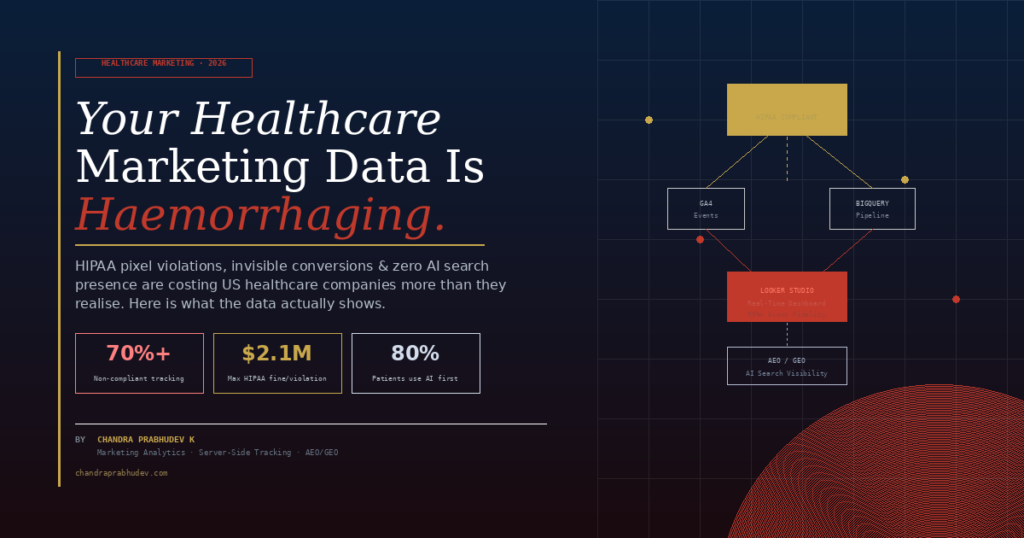
Over 70% of US medical practices are running non-compliant tracking right now. At the same time, patients are switching from Google to ChatGPT — and most healthcare brands have zero AI search presence. Here is what both problems are costing you, and what the fix looks like.
In 2023, the US Department of Health and Human Services issued guidance that sent shockwaves through healthcare marketing: standard website pixels — including Google Analytics and the Meta Pixel — constitute a potential HIPAA violation when placed on pages where patients enter protected health information. Appointment booking pages. Patient portals. Intake forms. Symptom checkers.
The same year, a seismic shift began in how patients search for healthcare information. ChatGPT crossed 100 million weekly users. Perplexity emerged as a serious research tool. Google launched AI Overviews across health queries. Patients started asking AI engines — not search bars — questions like “What is the best telehealth provider for anxiety?” or “Which fertility clinic near me has the highest success rates?”
Most US healthcare marketing teams are facing both crises simultaneously — and solving neither. This post breaks down what is actually happening across five healthcare segments, what the data loss and invisibility is costing them, and what a modern, compliant, AI-ready marketing stack actually looks like.
“33 of the top 100 US hospitals were found to have tracking pixels embedded on patient-facing appointment and portal pages — a direct HIPAA violation.”
— Markup / STAT News Investigation, 2023Why Your Healthcare Marketing Data Is Fundamentally Broken
Standard client-side tracking — the Google Tag Manager container sitting on your website, firing pixels directly from a patient’s browser — was built in a world before HIPAA applied to websites. That world no longer exists.
When a patient visits your appointment booking page and a GA4 tag fires, that tag can transmit the page URL (which often contains diagnostic or service information), the patient’s IP address, and behavioural signals to Google’s servers. Google will not sign a Business Associate Agreement (BAA) for standard Google Analytics. Which means that data transfer is, by HHS OCR’s current interpretation, a disclosure of Protected Health Information without authorisation.
You could have a perfectly legal website, a HIPAA-compliant EHR, and a careful patient privacy policy — and still be running an illegal marketing operation simply because of how your analytics tag fires. The fine range is $137 to $2.1 million per violation. The Office for Civil Rights is actively investigating.
Beyond the compliance exposure, there is a performance problem: iOS privacy changes, browser-level ad blockers, and third-party cookie deprecation now block 30–40% of client-side tracking events by default. For healthcare companies running significant paid media budgets, this means your reported conversion numbers are structurally understated. You may be making budget allocation decisions based on data that is missing a third of its signal.
The Exposure Is Not Theoretical
Between 2023 and 2025, US healthcare organisations paid over $100 million in HIPAA pixel-related fines and settlements. The defendants were not small clinics — they included major hospital systems, telehealth platforms, and health insurance providers.
The mechanism was the same in nearly every case: standard GA4 or Meta Pixel tags deployed on patient-facing pages, transmitting behavioural data to third-party servers without a BAA in place.
Server-side tag management — moving your analytics infrastructure onto a server you control before any data reaches Google, Meta, or other platforms — is now the industry-standard compliant solution. It gives your marketing team the data it needs while you retain full control of what information leaves your environment.
Your Patients Are Asking ChatGPT. Your Brand Isn’t in the Answer.
Traditional SEO was built around a simple mechanic: rank highly in Google, get clicks. Healthcare organisations spent years and significant budget on keyword rankings, domain authority, and backlink profiles — all to appear in a ten-blue-links search result.
That mechanic is being structurally disrupted. When a patient types “best telehealth platform for chronic pain management” into ChatGPT or Perplexity, they receive a synthesised answer — not a list of links. The AI cites sources it has determined to be authoritative, structured, and semantically rich. If your content is not structured in a way that AI models can parse, extract, and cite, you simply do not exist in that answer.
AEO and GEO are the disciplines of structuring your brand’s digital content — pages, FAQs, schema markup, entity relationships, and topical authority signals — so that AI engines cite you in their generated answers. For healthcare companies, this is no longer optional. The brands that appear in AI answers in 2026 will dominate patient acquisition in 2028.
The opportunity is significant precisely because the space is early. Most healthcare marketing teams are still optimising for Google rankings. A focused AEO/GEO strategy implemented now — structured FAQ content, HowTo and MedicalCondition schema, entity coverage aligned with how AI models understand healthcare — creates a durable advantage that compounds over time.
Five Healthcare Segments Facing These Challenges Right Now
These problems are not uniform across healthcare. The urgency, the specific data exposure, and the AI visibility gap varies significantly by segment. Here is how each one is affected — and what solving it actually looks like.
What Is Happening
- Standard GA4 + Meta Pixel on intake and onboarding flows — direct HIPAA exposure
- 30–40% of patient journey events blocked by iOS and ad blockers — invisible conversions
- No attribution model — can’t tell which channel actually acquires paying patients
- Competitors appearing in ChatGPT health answers; they are not
- 5+ disconnected ad platform dashboards with no unified source of truth
What the Fix Looks Like
- Server-side GTM stack that intercepts all events before they hit Google or Meta servers
- Meta Conversion API (CAPI) deployed server-side — compliant, higher match rates
- Multi-touch attribution model exposing true patient acquisition cost by channel
- AEO content framework targeting AI answers for key health queries
- Unified real-time dashboard across all channels and patient segments
What Is Happening
- Appointment booking pages firing standard pixels — confirmed PHI transmission risk
- Spending $20K–$100K per month on Google and Meta Ads with unreliable attribution
- Location-level performance invisible — no per-clinic breakdown in reporting
- Patients searching “best fertility clinic near me” in Perplexity — brand absent from AI results
- Marketing data trapped across 10+ disconnected platforms
What the Fix Looks Like
- HIPAA-compliant server-side tracking preserving conversion data without PHI exposure
- Per-location attribution model identifying true cost-per-appointment by clinic
- FAQ and LocalBusiness schema structured for AI engine citation
- Consolidated dashboard showing all location performance in real time
- Paid media audit identifying and eliminating wasted spend immediately
What Is Happening
- Member portals are one of the highest-risk zones for PHI transmission via pixels
- OCR has specifically flagged portal-based tracking in recent enforcement guidance
- Multi-stakeholder journeys (members, employers, brokers) create attribution complexity that standard analytics cannot handle
- Members ask AI engines “which Medicare plan is best for me” — most platforms are not in those answers
What the Fix Looks Like
- Server-side infrastructure keeping all portal event data within a controlled environment
- Separate attribution models for member, employer, and broker journeys
- GEO content strategy targeting Medicare, benefits, and plan comparison queries in AI
- Unified cross-stakeholder marketing dashboard with executive-ready reporting
What Is Happening
- Small marketing teams with no dedicated analytics function — flying blind on spend
- Hospital and health system buyers now research software tools via ChatGPT and Perplexity — HealthTech companies without AI presence lose deals before a demo is ever requested
- Google and LinkedIn Ads running without reliable conversion tracking — wasted budget compounding monthly
- No real-time pipeline dashboard — marketing cannot demonstrate revenue contribution to board
What the Fix Looks Like
- GA4 + server-side event tracking built for B2B SaaS conversion funnels
- BigQuery data pipeline and Looker Studio dashboard showing pipeline by channel
- GEO strategy targeting “best [clinical AI / care platform] software” in AI engines
- Fractional CMO providing senior strategy without the full-time hire cost
What Is Happening
- Healthcare clients are asking for HIPAA-compliant server-side tracking — most agencies cannot deliver it
- Clients requesting AEO/GEO audits — almost no agencies have this capability yet
- BigQuery and advanced attribution work being lost to more technical competitors
- Need to expand technical services without hiring full-time senior engineers
What the Fix Looks Like
- White-label server-side tracking implementation delivered under your agency brand
- AEO/GEO audits and content framework — fully white-labelled
- BigQuery pipeline and dashboard builds as a technical subcontract
- Senior analytics capacity on retainer without a full-time headcount
Segment Comparison — Risk, Revenue & Priority
| Segment | Primary Risk | Key Services Needed | Monthly Value | Priority |
|---|---|---|---|---|
| Telehealth Startups | HIPAA pixel exposure + AI invisibility | SS Tracking, AEO/GEO, Attribution | $5K–$15K | 🔴 Critical |
| Specialty Practice Groups | PHI transmission on booking pages | SS Tracking, Paid Media Audit | $3K–$8K | 🔴 Critical |
| Health Insurance Portals | Portal PHI exposure, OCR enforcement | SS Tracking, Data Stack, GEO | $10K–$20K | 🟠 Urgent |
| HealthTech SaaS (A/B) | Blind paid media + no AI presence | AEO/GEO, Fractional CMO, Dashboard | $8K–$15K | 🟠 High |
| Healthcare Agencies | Capability gap losing client work | White-Label Tracking, AEO/GEO | $2K–$6K | 🟢 Fast Win |
Two Problems. One Moment to Fix Them.
The healthcare companies that navigate 2026 successfully will be the ones that solve both problems simultaneously: bringing their tracking infrastructure into compliance while building their AI search presence before competitors make it a priority.
These are not separate workstreams. A server-side tracking architecture that gives you clean, reliable data also gives you the foundation for more accurate attribution, better paid media performance, and real-time dashboards that actually reflect patient behaviour. An AEO/GEO content strategy that makes you visible in AI answers also strengthens your technical SEO, your schema markup, and your organic authority.
The organisations that treat these as integrated problems — rather than isolated IT and marketing tasks — will compound their advantage every quarter. Those that delay will find the gap increasingly difficult to close.
“The HealthTech companies that build AI search authority in 2026 will be the default answers in AI engines by 2027 — the same compounding advantage that early SEO investment created a decade ago.”
— Chandra Prabhudev K, Marketing Analytics & AEO SpecialistIs Your Healthcare Brand Exposed? Let’s Find Out.
I offer a free 20-minute Marketing Compliance & AI Visibility Audit for US healthcare companies and agencies. We look at your current tracking setup, your AI search presence, and your attribution model — and I tell you exactly what I find.
Book a Free Audit View Services